My article about Morocco in Helsingin Sanomat

Yesterday my first article that I reported from the African continent was published in Finland. It’s a hotel review of sorts that I wrote for Helsingin Sanomat, Finland’s largest newspaper (that I modestly like to call “our New York Times“). I contribute pretty frequently for the travel section of HS, often about New York but sometimes about other places around the world as well.

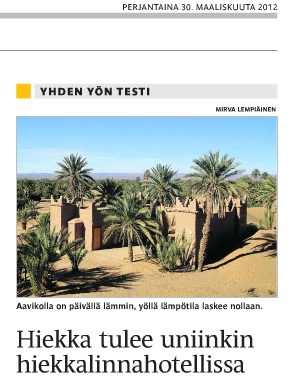
This most recent article was part of a series called “A One Night Test”, where the writer spends a night in a unique hotel  and reviews the experience. I wrote about the dreamy desert oasis hotel of Ait Isfoul in Morocco, where I actually spent a whole week, as you may remember reading earlier.  This was not a story that I pitched myself, but instead one of my editors read my blog post and thought that a write-up of this sand castle would fit well within the “One Night Test” series. And here’s the result:


Unfortunately the print is tiny so it’s impossible to read the article online, and it is also in Finnish, which might be a small problem for some of you. 🙂

But since the article is not too long, I quickly did a rough translation of it for you. Those of you that prefer to read it in Finnish can find the original Finnish version pasted after the English one.

So here you go:

In the sand castle hotel, you’ll even be dreaming of sand

MOROCCO. Even in the pitch-black darkness you notice it. The hotel is like a carefully crafted sandcastle.

The fine sand of the Sahara crunches under our feet and smells in the air when we step out of the desert hotel owner’s black BMW. Millions of stars shine above us – the sky is even brighter than in Finland in the dead of winter. The temperature has gone down to zero. (I’m talking about Celcius here – that is -32 Fahrenheit.)

The main building’s high towers poking in the sky are reminiscent of the palace in Nintendo’s Mario Brothers game where the evil demon is holding the princess hostage. But here it’s not a princess who is held in captivity, but a price of sorts. Kamal Yassine, 26, has inherited the hotel and runs it with four of his friends.

My room is in the annex building. Cold air seeps in through the windows. All three blankets come into good use.

IN THE MORNING the donkey’s hollow cry welcomes the new day. Rays of sunshine light up the room. The walls are made of clay, there’s a blue-orange rag carpet on the floor. The window of the bathroom has been tucked shut with thin pieces of wood and scraps of plastic. Still,  the overnight sandstorm has caused sand to pile up on the floor.

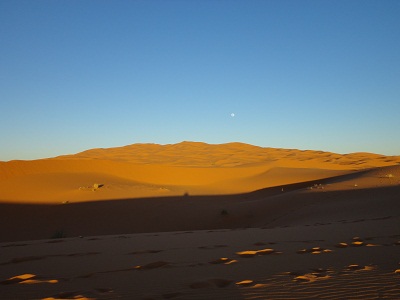
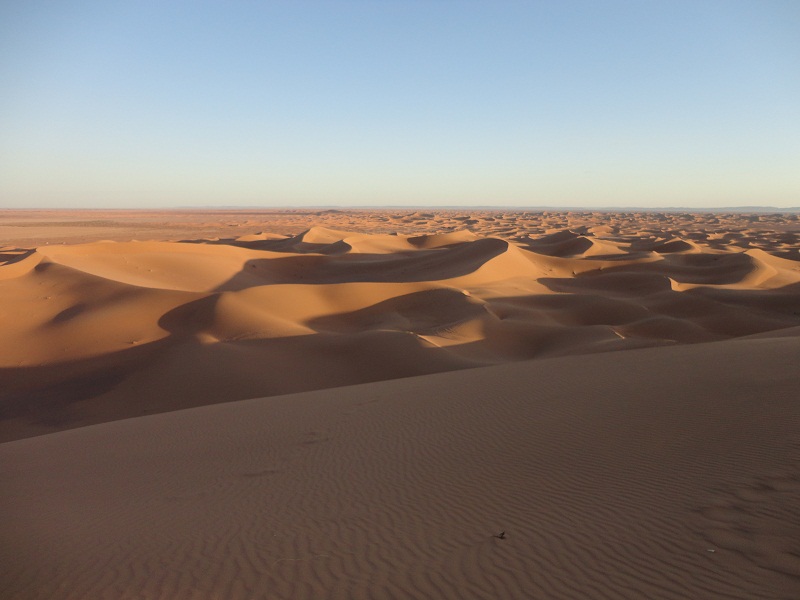
Outside, an unreal view awaits: there are wave-like sand dunes  as far as the eye can see. They start right underneath the window as gentle ripples and grow into 30-meter tsunamis further out.

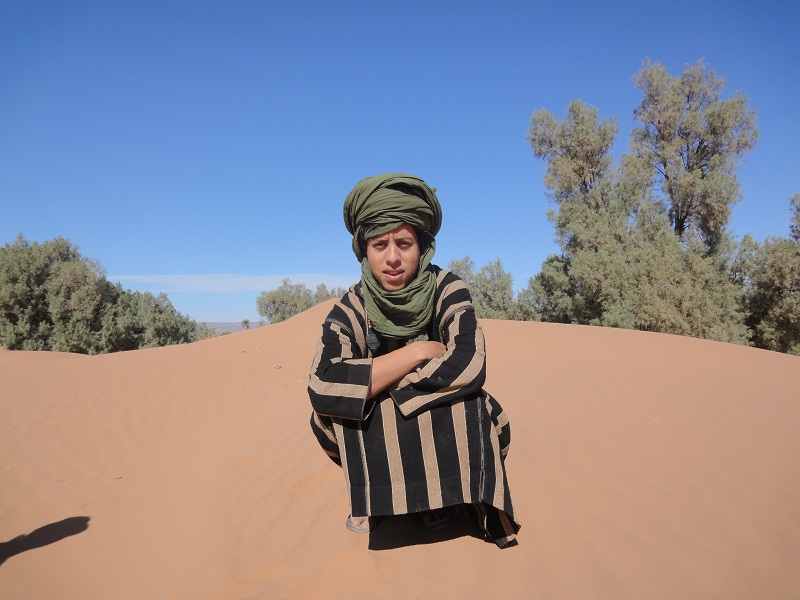
The breakfast consists of white bread, jam and overly-sugary tea. Our host Yassine has traded his black leather coat for a traditional North African outfit, a mossy green turban and an ankle-length jilaba jacket.

“I didn’t wan’t to scare you with these clothes last night. Maybe then you would have been too afraid to get into my car,” he laughs.

THE DESERT HOTEL stay includes a full board. A room for two costs 15 euro per person, or 30 euro per person with your own bathroom.

In the winter season the hotel is quiet and the host has time to entertain his guests. We go camel riding, admire the sunset from the dunes and listen to Berber songs by the bonfire.

www.aitisfoul.com

AND THE SAME THING IN FINNISH:

Hiekka tulee uniinkin hiekkalinnahotellissa

MAROKKO. Säkkipimeässäkin sen huomaa. Hotelli on kuin taidokkaasti taputeltu hiekkalinna.

Saharan hienojakoinen hiekkaa narskuu jalkojen alla ja tuoksuu ilmassa, kun astumme ulos Ait Isfoulin aavikkohotellin omistajan mustasta bemarista. Yläpuolella loistavat miljoonat tähdet – taivas on säihkyvämpi kuin Suomessa sydäntalvella. Lämpötila on laskenut nollaan.

Päärakennuksen korkeuksiin sojottavat sahalaitaiset tornit tuovat mieleen Nintendon Mario Brothers -pelistä tutun palatsin, jonne ilkeä örkki on vanginnut prinsessan. Mutta täällä ei ole vankina prinsessaa vaan pikemminkin prinssi. Kamal Yassine, 26, on perinyt hotellin ja pitää sitä nyt pystyssä yhdessä neljän ystävänsä kanssa.

Majoitun sivurakennukseen. Viima tunkee sisään ikkunoista. Kaikki kolme huopaa tulevat tarpeeseen.

AAMULLA aasin ontto kiljunta herättää uuteen päivään. Auringonsäteet valaisevat huoneen. Seinät ovat savea, lattiaa koristaa sinioranssi räsymatto. Kylpyhuoneen ikkuna on tikattu umpeen ohuilla puilla ja muovinsuikaleilla. Santaa on silti lentänyt lattialle öisen hiekkamyrskyn jäljiltä.

Ulkona odottaa epätodellinen näky: meren lailla lainehtivia hiekkadyynejä silmänkantamattomiin. Ne alkavat ikkunan alta loivina liplatuksina, kasvaen kauempana kolmekymmenmetrisiksi hyökyaalloiksi.

Aamupalaksi tarjotaan vaaleaa leipää ja hilloa, sekä ylisokeroitua teetä. Isäntämme Yassine on vaihtanut mustan nahkatakkinsa perinteiseen pohjoisafrikkalaiseen asuun, sammaleenvihreään turbaaniin ja nilkkoihin ulottuvaan jilabatakkiin.

”En viitsinyt säikäyttää teitä vielä eilisiltana näillä vaatteilla. Ties vaikka ette olisi uskaltautuneet autoni kyytiin ollenkaan”,
hän nauraa.

AAVIKKOHOTELLISSA on täysi ylläpito. Kahden hengen huone maksaa 15 euroa henkilöltä, oma WC nostaa hinnan
30 euroon.

Talvikaudella hotellissa on hiljaista ja isännällä on aikaa viihdyttää vieraitaan. Ratsastamme kameleilla, ihailemme auringonlaskua dyyneillä ja kuuntelemme berberiheimon lauluja leiritulella.

www.aitisfoul.com

The Art of Traveling Light

A few weeks ago I wrote about the five unexpected benefits of traveling light, and in the end promised that I’d share my own packing tips with you soon.

My apologies that it took a while for me to get back to you on that, but here I am, ready to address all your questions and packing concerns with:

 Mirva’s Ultimate Guide to Traveling the World with a Carry-On

Before you get started, here’s my disclaimer: this information may not be suitable for mountaineers, hikers, skiers, winter enthusiasts, campers or globetrotting opera singers.  This advice is geared for typical travelers who are heading to those predominantly warm destinations – Australia, Asia, Africa, South America, the Caribbean  – and who plan on mostly sleeping in hotels, hostels or private homes, not outdoors. Also, some of this advice may not apply as well to guys as it does to girls. Sorry about that.

Still, this post will include information that may also benefit those above-mentioned groups and several others. Just remember that anything you read here should not be taken at face value – what works for me may not work for you – and is best used as a guide that can be modified to suit your needs.

Everyone has their own “must-have-items” while traveling, so please do not get offended if I have left out the one item without which you absolutely cannot live. For each his own! That said, here is my advice that comes from 10+ years on the road.

The Three Things You Think You’ll Need, but You Really Do Not

1)      Jeans

This may come as a shock for you blue jeans lovin’ folks out there but these heavy, cumbersome and hard-to-dry pants are the first absolute no on my packing list. You know how much space those take out of your little bag? And you know how much they weigh? A lot. Let’s face it, you plan to chill on the beach for the majority of your vacation anyway and jeans do not belong in that scene at all.

I realize you may want to bring a pair with you ‘just in case’, but I am telling you – it’s not worth it. Instead bring a few of the following: light-weight khakis, a thin pair of black pants, capris, shorts, sweatpants, skirts, dresses, leggings or even jeggings –basically anything is better than a pair of jeans. And if you are one of those countless people who just cannot imagine life without jeans, then fine, bring one pair. But make sure that it is of the lightest fabric you can find and be prepared to wear it whenever you are on the move: changing cities, flying somewhere or sitting in a bus for 30 hours. At least that way the jeans won’t take up precious space in your bag. Just don’t come complaining to me that you’d rather be wearing shorts or a nice dress in this heat! In all my travels around Asia, Australia, Latin America and now Africa I have never once wished I had brought jeans with me. Instead, long skirts are my staple travel wear (perfect also for countries where you shouldn’t show much skin). Whenever I get cold, I just wear leggings underneath.

2)      Sleeping Bag

I used to travel with a sleeping bag at all times though I wasn’t planning on doing any camping. I just brought it along in case the blankets in my hostels would not be warm enough or I’d take a night bus where the AC was on full blast. How many times did I actually roll the sleeping bag out of its case? A handful, at the very most, and even then I used it mostly just to get at least some use out of it.  Thus hauling a sleeping bag around for months just in case was hardly worth it. Nowadays I travel without one and have never regretted it. Every hotel gives you a blanket, and hostels too. When I have gone Couchsurfing, every host has offered me a duvet or a blanket or at least a sheet. And should you ever find yourself really needing a sleeping bag – well, just deal with it somehow. Wear layers, cuddle up with someone, tear down the curtains of the hotel room, use a scarf as a blanket… Be creative.

(The only time my sleeping bag came in handy in Australia in 2006 was during a visit to Byron Bay with my friend Kaisa, pictured here. The bus dropped us off at 4.30 a.m., and we didn’t want to splurge on a night’s accommodation when the night was almost over anyway.)

Nowadays I’d rather experience a chilly night once or twice during my trip than haul extra weight around for months. If you absolutely want to bring something to calm your nerves, get one of those slip-in silk sleeping bags that weigh nothing (and are meant for avoiding contact with dirty sheets) or “borrow” one of those handy, light airline blankets.

3)      Towel

While I started off traveling with a fluffy normal towel, over the years my towels just got smaller and smaller, until I finally was down to a tiny kitchen rag. You really do not need much more than that to pat yourself dry. Air-drying is so underrated! And if you love wrapping yourself in a big towel after taking a shower, don’t worry. Many guesthouses and hotels will supply you with one. Also, being deprived of a real towel for a while will help you appreciate the luxury when you come across it. For me that is part of the point of travel – learning to enjoy things you used to take for granted.

(Here I am, loving my most recent borrowed towel in Senegal’s Casamance region)

On the other hand, here are the…

Three absolute  must-haves for a traveler

1)      Sarong

If I could only take one item with me on my trip, a sarong would be it. If you are not familiar with the term, a sarong is a thin, colorful piece of fabric that is sold pretty much in every beach town worldwide.

If you do not already own one, make sure to buy one when you hit the road. You can rest assured, there is not a single item in this world that is more multi-functional than a sarong. I use mine as a towel for the shower and the beach (which is why I often do not even bring the little kitchen rag with me anymore), as a blanket in chilly buses and planes, as a sheet or a pillow case in one-star hotel rooms. I wrap it in my head like a turban or around me like a dress.

I even wore a flowery sarong to a Cambodian wedding once! I sometimes carry things inside my sarong, or hang it down from my hostel bunk bed to create an illusion of privacy. I use it as a curtain or as art on the wall. The sarong simply cannot be beat! I usually buy a pretty one from every trip and keep it as a multi-functional souvenir.

2)      Bolero

As with jeans, many people feel the need to bring a bunch of long sleeve shirts along just in case. But unless you are going to a Muslim country, a place with an abundance of malaria or some chilly high altitude towns, you will not get much use out of long sleeve shirts. But since you’ll still want to be prepared for chilly days or nights, the best solution is to bring a bolero or two. A bolero refers to those add-on sleeves that were trendy some five years ago, and are still super trendy in my books as the ultimate travel accessory (hence I’m wearing a bolero in the sarong photo above!). Just throw on a bolero and voila – your sleeveless top has turned into a long sleeve shirt! The best part is that you can wear the bolero with any of your tops, and it weighs much less than a full long sleeve shirt. So even if you never end up needing to wear it, it’s not a big loss weight-wise. The only thing is that boleros are a bit hard to come by these days. So if you see one sold, grab it right away! In fact, I just spotted some in a store in Dakhla, Western Sahara, if anyone is heading that way…


3)      Mini-size shampoos and other beauty products

You know those mini-size shampoos and conditioners that you get at hotels? That is what you should be traveling with too. There is absolutely no reason for you to haul around full-size lotions and potions that take up half of your luggage (yet many people still do!). I bring just a tiny shampoo bottle with me – well, everything I bring is tiny in fact! Here’s a half-liter water bottle as a size comparison.

This black miniature shampoo bottle in the middle lasts me a couple of months, easily.

“How?” you may ask. Well, for one, I have trained my hair so that it only needs to be washed once or twice a week. Other days I just take a shower without washing my hair, which is a great time and shampoo saver. Secondly, I’ll refill the little bottle from time to time from the big bottles that other travelers are hauling around – they are usually more than happy to get rid of a few extra ounces of weight. Or if need be, I’ll buy a bigger bottle to refill from and give the rest to another needy traveler or a local.

(Note: If you think that your hair cannot be trained not to get greasy every day, you are wrong. It definitely can – you just might not want to be seen in public during the training period as it takes a few weeks. Getting braids makes the process a whole lot easier. Your hair doesn’t need to be washed more than once a week after it is braided, and you can continue on that path even after you take the braids off.)

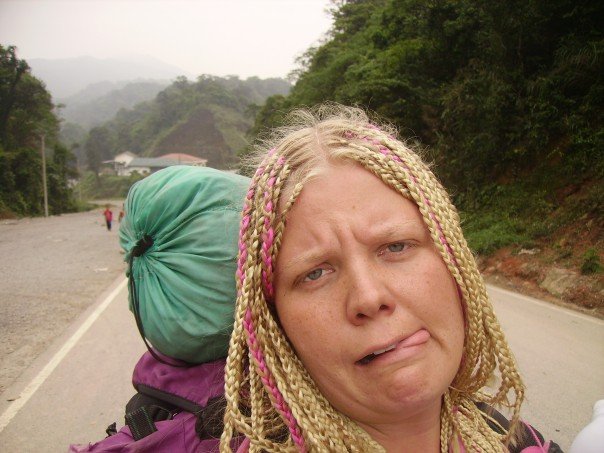
  (Braids are also a great ice-breaker when traveling. People cannot wait to touch your strange hair, at least when you have partly pink braids…)


What did you think about these tips? Were any new to you? I still have a few more up my sleeve, so stay tuned…

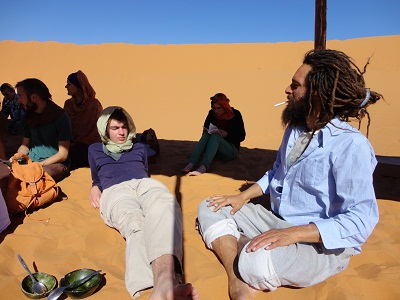
24 people, 6 days, 1 Sahara

What happens if you bring 24 strangers together and isolate them from the world for six days in the middle of the Sahara Desert? Unexpected things, I tell you.

And I am speaking from experience, as I was one of these 24 travelers to take part in The Road Junky Sahara Retreat this February. The retreat, which I randomly came across online in January, was the main reason I chose to start my African tour from Morocco.

In case you haven’t heard of Road Junky Travel, it’s a web magazine dedicated to travel stories and videos. This year was the second time that Tom Thumb, one of the website’s founders as well as a writer, storyteller and permanent nomad from England, organized this retreat in the desert. As last year’s camp was such as success, Tom decided to make this year’s stint a day longer, five nights and six days.

The Road Junky Sahara Retreat was advertised as a travelers’ meet-up, and a chance to meditate in the vast emptiness of the Sahara, and participate in workshops of yoga, aikido and dance. There would also be travel stories shared around the fire, and evenings spent listening to Tom reciting tales from the “1001 Nights” collection.

Those of you who know me probably remember that I am not into yoga, I definitely never meditate and I have never expressed even the slightest interest in aikido. A few years ago at the CUNY Graduate School of Journalism I did participate in some martial arts classes held by Sensei George, but mostly just to show my support. I was never a natural-born Jackie Chan, nor into any remotely hippie-sounding spiritual stuff.

Add to this equation that I don’t like being far from the ocean, having grown up on an island four hours
off the coast of Western Finland. As an adopted New Yorker, I also don’t feel particularly comfortable
when I am far away from the hustle and bustle of city life. Three days is usually the max I can handle being in a remote location without getting anxious.

Yet somehow I felt drawn to this idea of spending a week amidst the sand dunes in the Sahara, so much so that I decided to shell out the 250 euro the retreat cost and sign up. I wanted to see how bright the stars would be, whether the yellow sand dunes were really as spectacular in real life as they looked in
photos, and whether I could actually learn to enjoy these activities I had no previous interest in.

As I mentioned in the beginning, unexpected things will happen if you bring 24 people to the Sahara Desert. An anti-American hippie will befriend a clean-cut Midwestern guy, a vegetarian will succumb to the smell of delicious chicken tajine and a reserved German will throw himself in the middle of a cuddle puddle of entangled human bodies. Unlikely friendships will form, long-overdue tears come running out at the sight of the most beautiful sunset and strangers will care for each other as if they were family.

A black-clothed heavy metal singer with a pony-tail Mohawk will turn into a hug monster, and a sandstorm will blow away a songwriter’s creative block. A hyper, cynical city girl will enjoy yoga, aikido and dance therapy lessons held in the middle of nowhere.

Yes, that was me stretching myself in unlikely positions at the crack of dawn, welcoming pretend-attackers into my invisible circle, searching for my sphere of energy and sensing that of others. Without thinking about how silly I looked, I allowed myself to imagine I was as light as a feather dancing in the wind and as heavy as a stone laying in the sand. I learned to lean on other people both physically and mentally, which is at times hard for those of us who are fiercely independent souls.

No matter how “hippie” some of the exercises seemed for my taste, I decided to face this retreat with an open mind and see if it would lead to something new, whatever that might be. After all, “if you always do what you always did, you’ll always get what you always got.” And I did enjoy doing things differently for a change, and interacting with the types of people I normally do not encounter.

And though I was even contemplating trying to meditate to the sound of people humming “ommmmmmm” around me, I didn’t quite get to the right mindset for that. The retreat was so action-packed that I just didn’t have time!

In case you are interested in joining next year, here’s what our daily schedule looked like:

-8 a.m. wake-up call: “Yoga in 10 minutes!”

-Crawling out of our tents into the fresh but chilly desert air

-Climbing over the dunes into the designated yoga spot

-Yoga for 45 mins to an hour: stretches, breathing exercises

-Breakfast: bread, yellow and red jam, olives, olive oil, endless cups of Moroccan tea

-Another call: “Aikido in 10 minutes!”

-Climbing over the dunes into the designated aikido spot

-Aikido for 45 mins to an hour: exercises with a partner, pushing, gentle shoving, how to avoid an attack by moving along with the attacker’s movements instead of fighting them.

-About an hour of free time

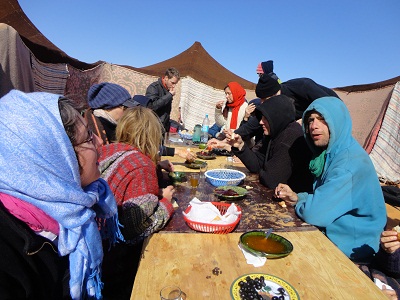
-Lunch: Bread with Moroccan soup consisting of orange broth with bits of tomato and quinoa. Orange slices for desert, as well as dates, wafers and nuts before and after lunch. More tea.

-Chilling and playing music in the sun for an hour, enjoying the heat that would be gone after sunset

-Another call: “Dance class in 10 minutes!”

-Climbing over the dunes into the designated dance class spot

-Dance class for an hour: touching one person in the group when the music ends, pretending to be a
tree or a traveler in a forest, trying to find your energy center and developing your own dance

-Time for sunset: climbing up one of the highest dunes to see the view. This is harder than you’d think.

-Trying to find your way back to the camp in the moonlight, getting lost for a bit and panicking ever so slightly

-Dinner time: chicken tajine, veggie tajine eaten out of communal bowls. Bread, tea and orange slices for desert.

-Climbing over the dunes to the designated fire spot

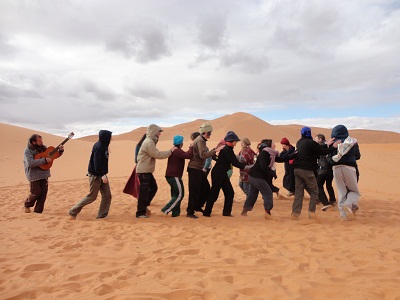
-Guitar music and singing around the fire, chatting, Tom telling 1001 Nights’ stories under the full moon. Most of them seemed to include a girl who was “as beautiful as…the moon, shining in the night sky.”

I was officially dubbed the most unromantic person on the retreat after jokingly questioning this funny metaphor. “How can you compare a woman to the moon? The moon is just a white blob! A rose maybe, but the moon?” 🙂

Overall the retreat was great fun and definitely helped me empty my mind of daily worries for a bit. Some of the things others mentioned enjoying were the friendships, sunsets, losing track of time in the desert, workshops, feeling the connection to the earth, sensing love and peace, seeing the moon rise out of the horizon and finding new energy for the future. All very hippie-sounding, but I guess that’s not such a bad thing after all.

If you think this retreat could be for you, keep checking the Road Junky website for details. The next one should be announced in the fall, and will be held around February/March 2012.

Trinidad & Tobago: the Ultimate Carnival Nation

Hey people – it’s CARNIVAL time!!

This year Feb. 20 and 21 are the official Catholic carnival dates. So the party is on in the ultimate carnival nation, Trinidad & Tobago! I can almost hear the music blaring from the loudspeakers of the trucks and see the Trinis shaking their hips in unison. The year’s most-awaited fiesta is finally here!

But of course the emphasis here is on the word almost, as I’m nowhere near the Caribbean at the moment.

Instead I’m sitting in the peace and quiet of Dakhla, an isolated town in Western Sahara. There’s no music to be heard, and not a single dance club in town. Instead there are countless cafes serving only non-alcoholic drinks and a nice ocean breeze blowing over to the beach boulevard from the turquoise bay. Whereas in T&T hoardes of women are currently prancing around in skimpy bikinis, here the ladies are covered head to toe with colorful fabrics.

But this stark contrast shouldn’t stop me from reminiscing about last year’s carnival, and telling you about it! After all, T&T’s carnival is something everyone should experience at least once in their lifetime.

So to get you into proper carnival spirit, let’s take a look at how I described the Trinidad & Tobago carnival last year in my old blog a week after the party:

Now that carnival and all the craziness is officially over, it’s time to look back and figure out what exactly happened during that whole week of non-stop action.

If there’s one thing I’ve learned, it’s that nobody takes carnival as seriously as the people of Trinidad. It’s been said that Trinis are either celebrating carnival, talking about the last carnival or planning the next carnival. I don’t have any doubt about that being true. After all, I met a person who had spent US$2,000 on their carnival costume and party tickets, and another one who had spent US$1,200 on flight tickets to be able to fly to Trinidad for a day and then fly back to the US for work the next day. I also witnessed some 80,000 people taking part in the carnival processions.

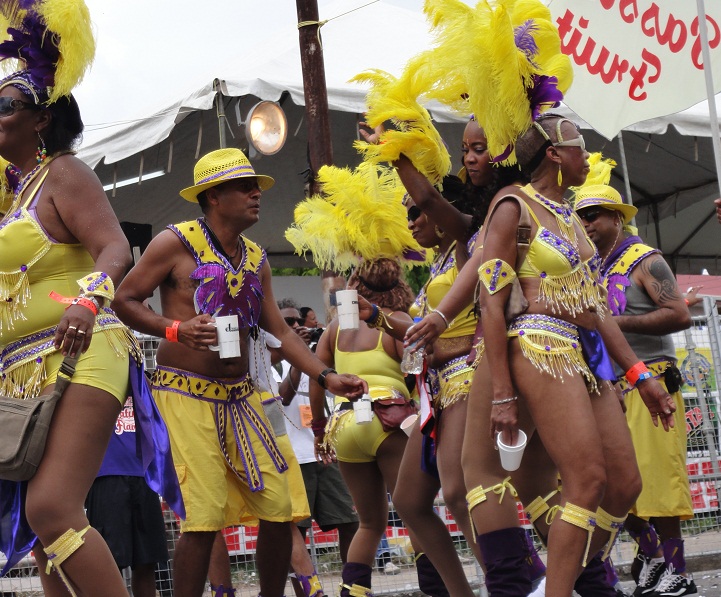
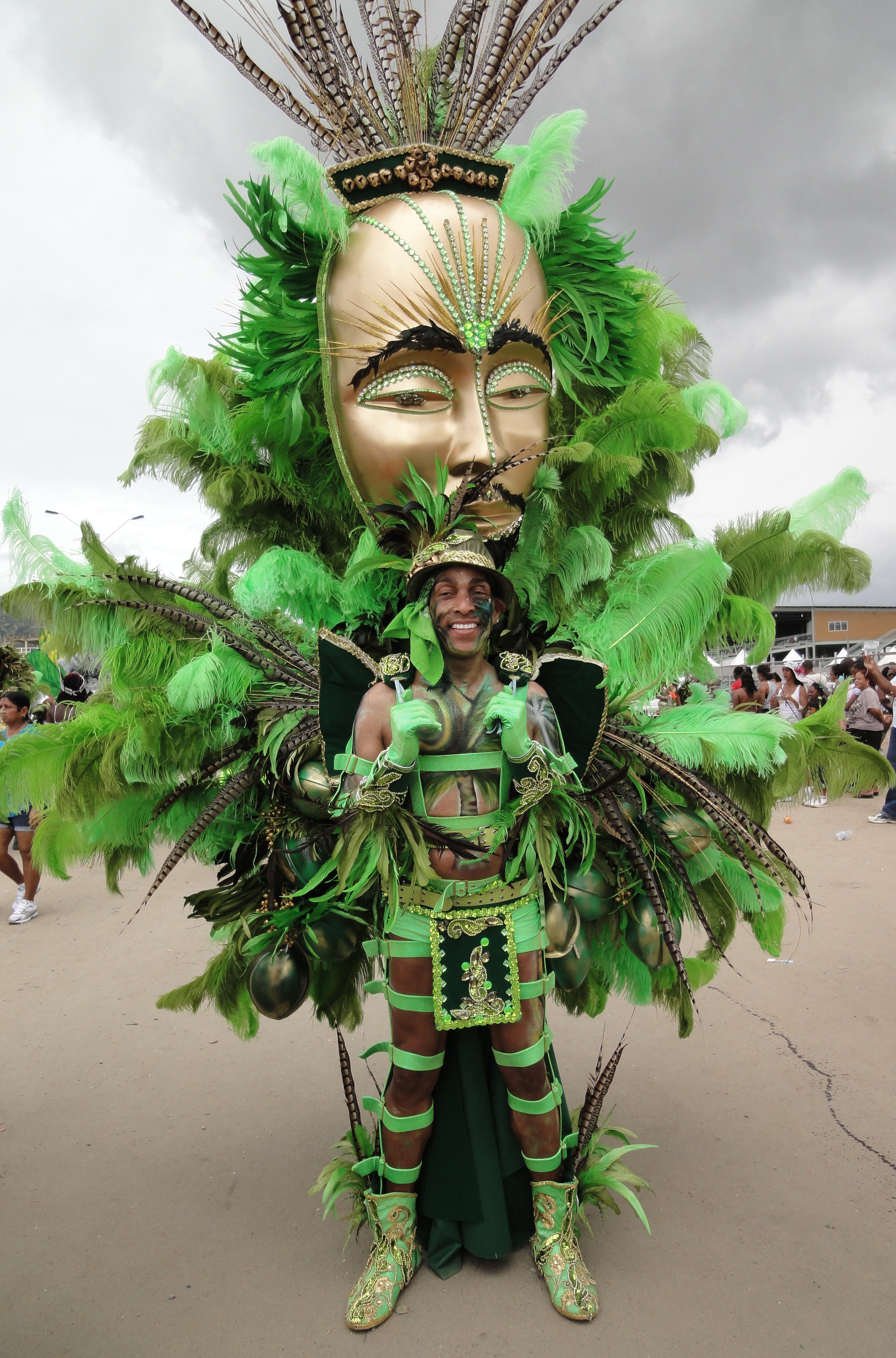
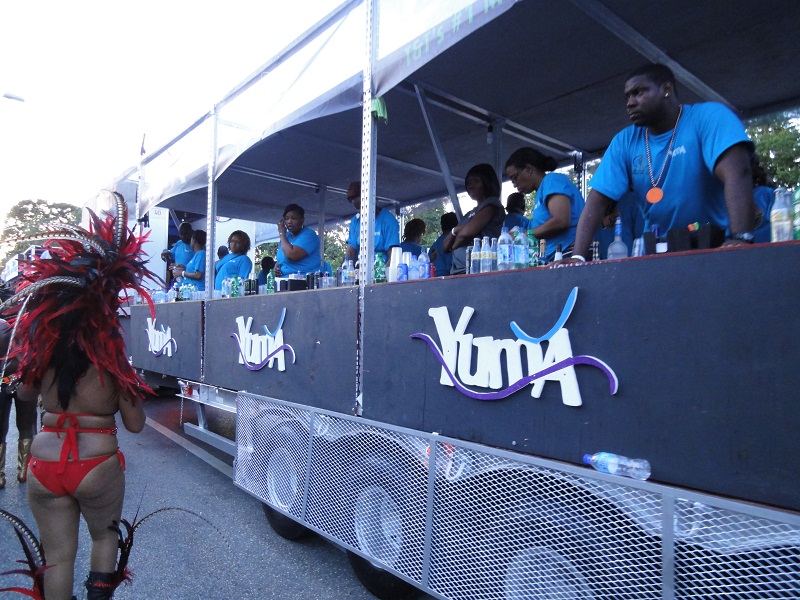
Whereas in Rio de Janeiro most people watch the carnival show from the comfort of their Sambodromo seat, in Trinidad they say 80 percent of the people actually take part in the show, and only 20 percent watch it. “Are you playing mas?” was the most popular question of the week, as was “Which band are you playing with?”. It took me a while to figure out that playing mas with a band had nothing to do with playing any kind of an instrument with a live orchestra. “Mas” refers to masquerading, and “band” refers to a set of trucks that have huge loudspeakers on them blasting music as they roam the streets. Some of the popular bands include Tribe, Yuma and Island People. Apparently there are slight differences in the types of party people each band attracts, but costume- and music-wise they all seemed very alike. The same Soca hits, the same colorful feather outfits and the same drinks (anything with Red Bull being the favorite). But people still seemed very patriotic towards their own group, which for my friends was Yuma.

Those that choose to play mas will thus don their skimpy outfits and dance next to a particular band (group of trucks) on Tuesday, the official carnival day. The highlight of the day is “crossing the stage” with your group, the official carnival stadium in the center of Port of Spain that was built a couple of years ago. One of this year’s biggest Soca hits, Machel Montano’s Advantage, talks specifically about the excitement of crossing the stage: “The stage is in front of us, time to take advantage of it!”.

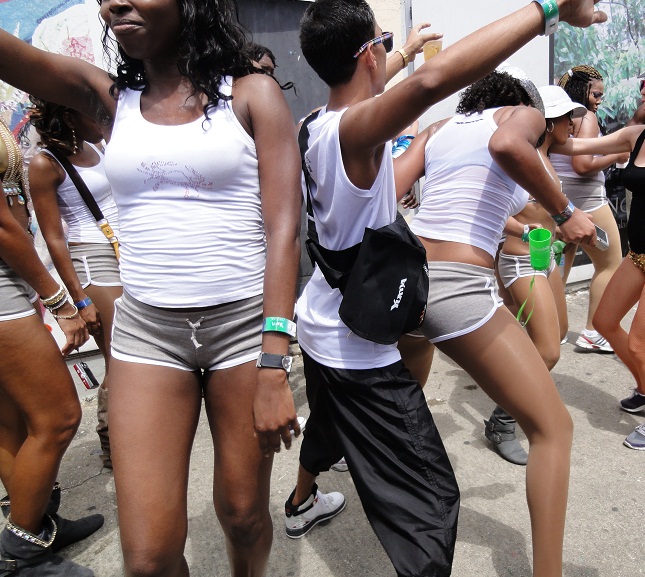
The previous day, Monday, is a “training day” of sorts when people wear their band’s signature T-shirt and shorts and follow the trucks for miles on end.

Much to the surprise of many, I had decided not to play mas. “Why would you come to Trinidad and not play mas? That’s the best part of carnival!”, people asked me. My answers varied from “I don’t feel like squeezing into a skimpy costume” to “I don’t have the energy to walk 20 miles after a truck” and to “I’d rather watch you guys from the audience.” The truth is that I just couldn’t justify spending $500 to “play mas” (nor did I have an extra $500 lying around anywhere!). Yes, you read right – five hundred United States dollars! That’s how much the tickets were for the two official carnival days, if you wanted to play with a band. The price included free drinks for the two days (from a moving truck that doubled as a bar), the band’s t-shirt and shorts, your skimpy carnival costume for Tuesday’s show, and a boxed lunch both days (a simple chicken and rice meal, served cold and often hours late).

Call me a cheapskate, but that to me sounds like a rip-off. Someone is making big bucks off the Trinis’ love for their biggest national holiday. A more reasonable price would have been $250, and even that would have still been way more than what I’ve ever paid for an all-inclusive party in New York. Granted, someone had to pay for the trucks and the security people, but the price still seems pretty steep to me. However, most Trinis seemed to think that paying $500 for two days of partying was a decent deal (never mind that $500 is the average monthly income in Trinidad, when all social classes are taken into account). And the remaining people must have thought that even though it isn’t an amazing deal, so what? It’s carnival! Time to splurge and engage in revelry! Take the skin off my back and sell my grandma’s house if it guarantees a good carnival!

If you still don’t believe that the Trinis’ devotion to carnival even beats that of Brazilians, check out this popular blog called Trinidad Carnival Diary by a woman who writes about carnival – 365 days a year. So yes, I missed out on the experience of playing mas (but I saved $500!). And I did sneak into the band my friends played with on Monday anyway, and walked and danced along with their trucks for miles just as they did. Then on Tuesday, when everyone was in their full costumes and thus blending into the group in regular clothes would have been harder, I watched the show from the Savannah stadium. Even this would have cost $80, but luckily I have friends in high places so I got in for free. 😉

Personally I think I got the best deal, and I didn’t mind missing out on crossing the stage on Tuesday. Quite the contrary, I was happy I didn’t have to get up at 5 a.m. to put on my make-up and costume, and then walk for 20 miles in the heat and try to keep up my party spirit until 10 p.m.! And this was after at least four days of partying, as the two official carnival days are preceded by a week of celebrations.

While it seems like every self-respecting Trini needs to play mas at least once in their lifetime (or preferably every year), I would recommend visitors to skip out on paying the $500 and just dancing next to the bands for free when you feel like it. The rest of the time you can pop into some of the bars along the parade route or make your way near the Savannah to see the groups preparing to go on stage. And anyway, as is the case with the full moon party in Thailand, the best parties are actually those that happen before the official celebrations. In Trinidad, one of the biggest fiestas is the J’Ouvert morning party. At 4 a.m. on Monday morning, thousands of people gather on the streets and cover each other with cocoa powder and paint and colorful powder. The end-result is a sticky mess, but it’s all good fun.

My personal favorite was the Veil breakfast party, which started at 4 a.m. on Sunday morning and went on until noon the next day (yes, the Trinis do party 24/7 during carnival!).
Not many parties are more fun than those where you dance outdoors to the beats of great Soca songs, and watch the sun rise out of the horizon. Finally at noon, sunburned and all partied-out, you get home and just crash. It’s then that you know that you’ve really made the most out of your carnival, like a true Trini.

Five Surprising Reasons to Pack Light

One of the most common travel questions I get is how to pack sensibly for a trip that lasts several months. My advice is always the same: pack as little as possible. Your body will thank you, and your mind will be at ease as you’ll have fewer material things to worry about.

Don’t let this old photo fool you. I’m currently roaming around the African continent with a tiny backpack that weighs about 9 kg, which is about 20 pounds, or 1.5 stone to those of you following the odd British measurement system. 😛

I plan to be on the road with this bag anywhere from three to six months. And even now I feel like I don’t need a third of the things I brought with me! Goes to show that there’s no such thing as packing too little. You’ll always make do with what you have, and most things that you need you can also get on the road. After all, your home country is not the only place where people use clothes to cover themselves and shampoo to wash their hair.

Not that I was always such a travel minimalist – far from it! I have just learned from experience. Back in 2006 when I headed to Australia armed with the one-year Working Holiday visa, I even packed rollerblades with me! Can you believe that?? Nowadays my entire bag’s contents weigh less than those bulky exercise shoes did. Yes, I still love rollerblading (and nowadays also kangooing), but I have also understood that you can’t have it all. As I wrote earlier, this lifestyle is all about making sacrifices.

And while I haven’t seen anyone else hauling rollerblades around, not a day goes by when I don’t see little backpacker girls carrying rucksacks twice their size, or guys trying to look macho while sweating profusely under their ginormous pile of stuff.

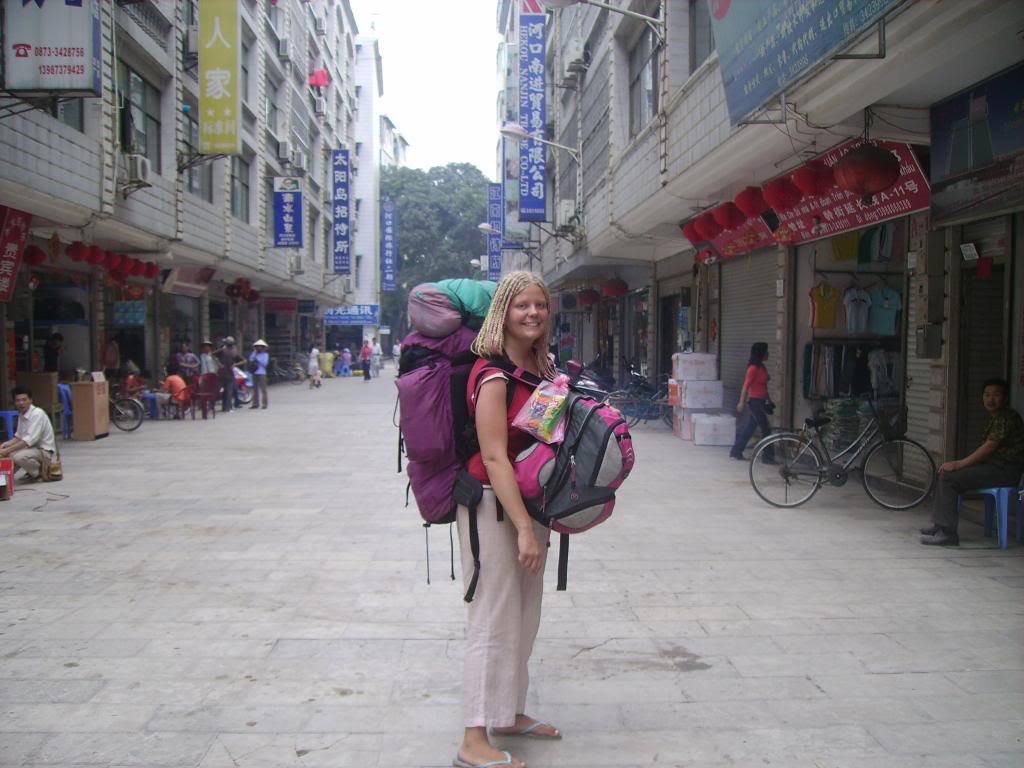
So what’s the big deal about packing light, you may be asking. Well, for one thing: people are not ants. We are not built to carry eight times our own bodyweight. But really, the answer lies in these pictures. Here I am on my Asian tour in 2007, carrying the world in my bag:


And here I am today, on the streets of Rabat, Morocco:

(Yes, I realize I look ridiculous in my long Moroccan jilaba robe, but it gets chilly here so I had to get one!)

Picture yourself having to carry one of these bags around every day for, say, five months. Which one would you rather choose? Yep, I would definitely take the latter one too. And I’m so annoyed that I didn’t come to my senses earlier! It was only during my one-month trip to Mexico in the end of 2008 that I first thought about bringing just a small day pack with me. (I figured if I could survive a week with it, I could do a month too.) And WHOA, what a difference that made! Not only was it much easier for me to move around physically, I also noticed the five major benefits there are to packing light:

1) Saving Money

You know those outrageous fees that airlines charge for checked-in baggage? Well, they don’t bother me, as my mini-bag counts as a carry-on. I have even managed to avoid baggage fees on Spirit Airlines, which is notorious for charging $20 even for a carry-on bag unless it is small enough to fit under the seat in front of you. And mine is! Also, buses in many developing countries charge about 50 cents to a dollar for each bag that is placed in the luggage compartment. I avoid that charge too, which may sound miniature but can mean savings of $50-100 over the course of a long trip.

2) Peace of Mind

Back in the day when I traveled with a huge rucksack, I constantly had to worry about it. Will my checked-in belongings make it onto the same flight as me? (Most of the time, no.) Will the bag still be in the luggage compartment of the bus by the time I get off? Has something been stolen from inside of it? Might someone slash the big bag open without me even noticing it? Those are not fun things to worry about, so I’m happy that I no longer have to spend time doing so. My little bag goes with me wherever I go, and is always at my sight. No more lost luggage worries whatsoever.

3) Increased Feeling of Security

Maybe this is not warranted at all, but I feel like I’m less of a target for potential robbers when I just carry a small bag (or at least I can run away faster!). If you arrive in a new town in a foreign country carrying a big rucksack, everyone can see that you are a newbie tourist. With a small bag, however, you can fool people into thinking that you have been around for at least a few days. For all they know you could be an expat walking around town with the day’s shopping in you bag, or a traveler going hiking, who has left most of his or her valuables in the hotel. Either way, big bag = much to steal, small bag = less to steal. The fact that I’ve never been robbed while traveling should speak for itself (knock on wood)!

4) More Room for Spontaneity

This one was the biggest surprise for me personally when I first started traveling light. I suddenly felt so FREE. Up until that point I hadn’t even realized how much my big backpack had controlled my life. Hauling the 20kg on my back like a mule had meant that my #1 priority in a new city was always finding a place to store my bag, which often meant having to book the night’s accommodation right off the bat. If it later turned out I didn’t like the town or the guesthouse after all, I just had to deal with it and stay there anyway since I had already paid. But now, with my tiny bag in tow, I can arrive in a new city, wander around for a couple of hours, and then hop on a bus to continue elsewhere if I feel like it. Perfect! This also helps with…

5) Saving Time

A prime example of how traveling light can save you time is my experience in Mexico: I arrived in Palenque in the morning, visited the Mayan ruins and a waterfall during the day, and then continued on a night bus to San Cristobal de Las Casas. I did all this while carrying my little bag with me. Thus I was able to see more in my one month in Mexico than the old heavy-traveling me would have in two months. And those hours that I used to spend huffing and puffing on the street desperately looking for a guesthouse to toss my bag in were now saved up and carefully spent on a beach instead. Not a bad trade off, huh!

Another time saver is being able to walk off an airplane and straight onto the taxi line without needing to stop by the luggage carousel to wait for your bag to arrive 30 minutes later (or worse than that, never). More often than not, this also means being first in the taxi line out of the people on your flight! Yay for traveling light!

So who is with me on this? What’s the silliest thing you have ever traveled with? I bet nobody else thought of traveling with rollerblades… More importantly, was I successful in inspiring you to travel light next time you go hit the road? If so, stay tuned.

Coming up: tips for how to pack light! Got any tips of your own to share?

Salam Alekoum from Morocco!

Hi everyone! Sorry for being out of the loop again. It’s surprisingly hard to get online when you are constantly on the go.

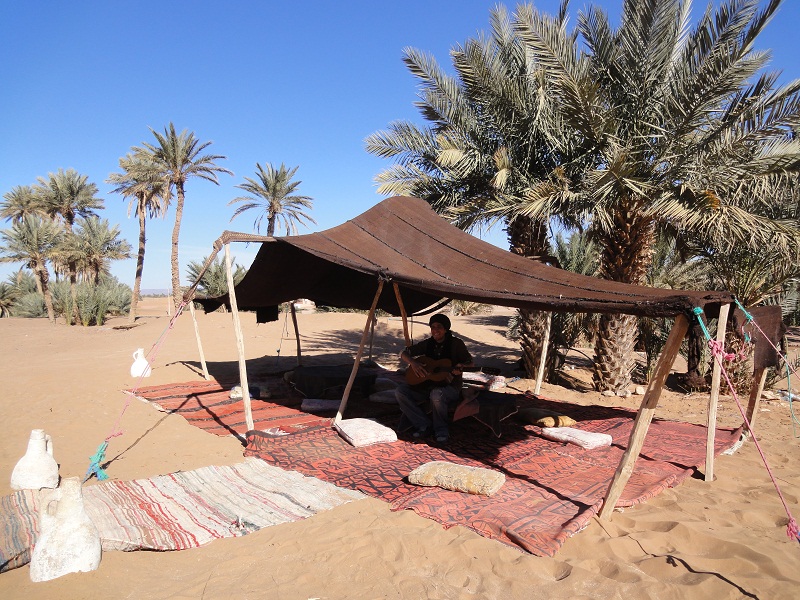
As I write this, I’m sitting in a palace-looking sand castle in the middle of the Sahara Desert. Well, almost anyway. I’m actually chilling in a small kasbah (village) in Southern Morocco in a house made of clay.  But it looks exactly like a fancy sand castle, as you can see here:

And the beige-colored dunes that start right from the backyard look almost identical to those you see in the middle of the Sahara, though we are actually just on the edge of the desert here.

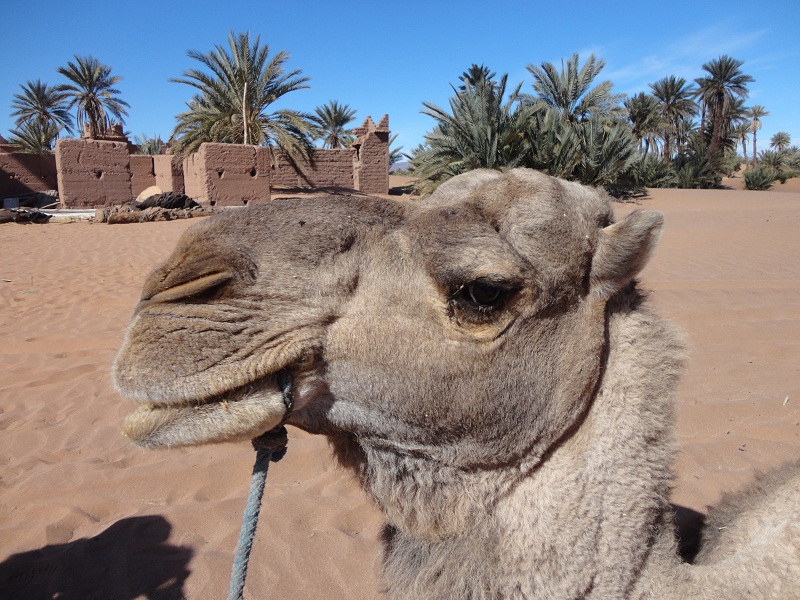
But make no mistake, this is definitely the desert.  The houses are all brown and made of clay, there are camels roaming around, and sandstorms are a true occurrence, not just a song by Darude (who is Finnish, btw!). The pet donkey’s hollow yelling has awoken me every morning this week.

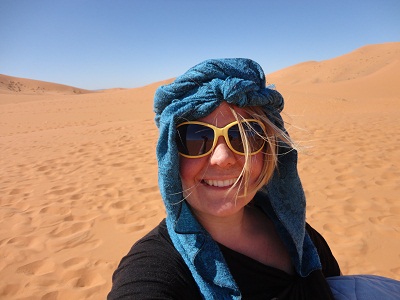
Unlike much of Morocco, this area of the country around the town of Tagounite seems very conservative. The call to prayer fills the air five times a day, the women all wear headscarves or full-on burkas, and men don the traditional outfit of the indigenous North African Berber people. That consists of an ankle-length robe called jilaba and a colorful turban, which helps keep the wind and sand at bay. Some of the turbans include up to nine meters of fabric! Here’s my new friend Kamal in his favorite desert man outfit:

So what exactly is this dreamy place and how did I end up here? After all, just a week ago I was skiing in chilly Finland. Suddenly the white snow has been replaced by various shades of brown, and the risk of running into wolves has turned into a chance to spot dromedars.

Well, the reason I’m in Morocco now is that this country is the first stop on my 3-4-month African tour. This means I have now officially set foot on every inhabited continent on earth, which was my goal for the first three decades of my life. Check!

And how I ended up in Ait Isfoul, the glorified sand castle that also doubles as a hotel, is because of Couchsurfing – Kamal and his friend Mohamed, fun and friendly Moroccan guys in their late 20s, are fellow members of the travelers’ network. They happily welcomed me and a Canadian couchsurfer girl, Melody, to spend a week in their desert oasis which Kamal has inherited from his grandfather. The guys do this every now and then when there’s a gap in the hotel bookings.

The difference between hosting paying customers versus couchsurfers, Kamal said, lies in the group dynamics. Hotel guests often prefer to do their own thing during the day, and will get lunch and dinner served for them. Couchsurfers, on the other hand, become a part of the Ait Isfoul family: we have cooked together, visited Kamal’s family in the nearby town of M’Hamid, gone camping in the deep desert and spent many nights around camp fires together with Kamal, Mohamed, Ibrahim, Mustapha, Hassan and whichever friend has happened to stop by. We also celebrated Mohamed’s birthday with a Moroccan barbeque.

It’s hard to say what has been the highlight of this unforgettable week. It has certainly been a busy one: we’ve gone riding with camels, gotten thoroughly scrubbed at a traditional hammam (bath house) by a feisty local lady, sandboarded down the huge Laabidlua dune in the Erg Chigaga part of the Sahara Desert (which I was terrible at), got our 4×4 jeep stuck in the dunes, learned to cook a delicious chicken tajine, met  a family of nomads… and we even had an impromptu dance party with some hilarious French people who stopped by Ait Isfoul for a picnic one day. Needless to stay, these have been some memorable days!

I’m also happy to report that the Sahara Desert is just as breathtaking as I had imagined. The night sky is the brightest I’ve ever seen (you can spot shooting stars every five minutes!), and the huge sand dunes continue as far as the eye can see. We even spotted a mirage – the heated air truly looks like water in the distance.

There were some surprises too, for example that as of last year they now have cell phone service in large parts of the desert. My phone got better reception there than at Times Square in New York! That was a relief, as I’d hate to get stranded in the Sahara, as beautiful as it is. I was also caught off-guard by how alive the desert was. There was hardly a moment when we were truly alone. Every 15 minutes we would encounter a herd of camels, a group of nomads fetching water from a fountain, another 4×4 jeep… so I guess it’s true what they say: if you get lost in the desert, stay where you are. Eventually someone will find you. (Or not, if this car below is anything to  go by…)

So a huge THANK YOU to Kamal and Mohamed and all their nice friends for all their hospitality. Ibrahim’s cooking is the best, and we will certainly miss the never-ending tea sessions. Hope to see you again sometime!

If anyone is looking for a truly authentic desert experience, don’t hesitate to get in touch with Kamal and Mohamed! If you are on Couchsurfing, you can find their profiles here:

http://www.couchsurfing.org/people/manodayak/

http://www.couchsurfing.org/profile.html?id=DXBMQ5P&from_search

If you are not into Couchsurfing, but are still  interested in staying in the most peaceful hotel in the Sahara, check out Ait Isfoul’s website for bookings: www.aitisfoul.com 

How many beds have you slept in?

The other day as I was lying awake at night, I decided I should start counting something to fall asleep. As counting sheep seemed a bit too mundane, I decided to try to remember the number of beds I slept in during 2011. As someone who is constantly on the move, I figured it would be quite a few. But I was still pretty surprised when the total came to 73.

(Hotel 25Hours in Hamburg, Germany)

Wow. 73 different beds in 365 days. That’s a new bed every five days. Or a couch, mattress, hammock or whatever it may have been.

Funnily enough, 2011 was actually one of my less mobile years: I spent more than a third of it living in Brooklyn, a bit less than a third visiting family in Finland and a third traveling around the world. That’s nothing compared to years when I’ve been on the move for six to eight months at a time. During those times I probably crashed at a new place every two or three days.

So what’s the big deal about this bed number of mine being so high? Well, for one thing it means I’ve had many changes of contracting bedbugs over the last years. Since I’ve stayed clear of them, I guess it means the world’s bedbug crisis is not quite as bad as we all thought. Phew.

But the real point I wanted to make about my 73 different sleeping arrangements is that it shows that this traveling lifestyle is not as easy as people think. You see, when I tell people what I do with my life (“I travel the world and write about it”), the most common comment I get is, “Oh, I’m jealous! Your life sounds amazing! You’re so lucky!”

Newsflash: More than luck, my lifestyle requires hard work and sacrifices. (I know, not half as appealing anymore.) How many of you could imagine changing beds every five days? And doing it for years on end… probably not too many. Most people like their own comfy pillows and blankets way too much to give them up. And don’t get me wrong – I love a familiar fluffy pillow as much as the next gal. But I also know that if I want to travel, that means giving up some things. One of the first ones is a place to call your own – you don’t want to be paying rent elsewhere while you are out roaming the globe. If you plan on only leading a semi-nomadic life, I suggest subleasing your apartment to someone while you are gone. Either way, you’ll have to get used to laying your head down in a new place every few days.

So where do I get my beauty sleep while on the road? Well, in different places: hotels, guesthouses, hostels, friends’ spare bedrooms or air mattresses, strangers’ couches (who I have befriended on the road, or met through traveler sites like Couchsurfing.com), hammocks, tents and sometimes in planes, buses, trains or even airports as I mentioned in my Quality Hunters blog. Yeah, not quite so glamorous anymore.

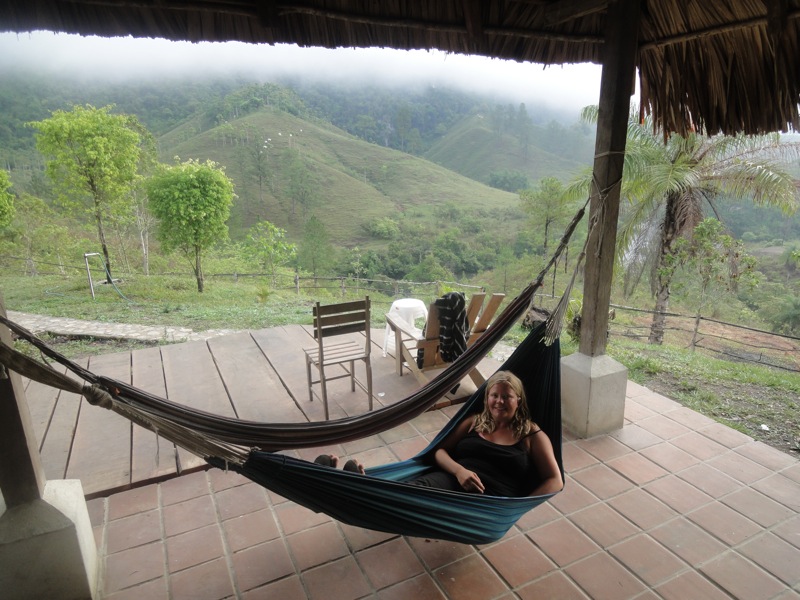
My accommodation in 2011 ranged from an outdoor hammock overlooking the mountains in Lanquin, Guatemala for $2 a night to a $350 hotel room in Amsterdam, Holland. So yes, I never know what awaits me! And that’s the beauty of it. Over my traveling years I’ve come to love the unexpected, and I thrive at not knowing where I’ll crash on any given day. I wouldn’t have it any other way right now.

(Zephyr Lodge in Lanquin, Guatemala. At $2 a night, you can’t beat this hammock accommodation for price nor the views!)
(Sakura Hotel in Tokyo, Japan, where the door slams into the bed every time you open it as the room is teeny tiny.)

(Le Méridien Bristol in Warsaw, Poland. Luxury for less: a room in this 5-star hotel costs less than 100 euro for up to two people as I wrote here.)

So next time you meet someone who travels a lot and you are about to exclaim, “I wish I could do that!”, just remember: you can. All you have to do is be willing to give up some of your home comforts and the sense of security that comes from living a stable life. In exchange you’ll get a life full of surprises, exotic foods, colorful cities, tropical beaches, new languages and international friends. Sounds like a fair trade to me!

And if you are ever having trouble falling asleep, I can truly recommend counting beds instead of sheep (as eventually I did fall asleep!). And once you do the math, please let me know what your total is! 🙂 Do you have me beat?

So, how was 2011 for you?

A decade ago around this time of the year I spent a balmy night soaking in a hot tub in San Marcos, California, surrounded by a group of international students from my college. It was just another one of those evenings spent chit chatting about school and the end of the semester, when suddenly Matt, our Brazilian friend, asked us all:

“So, how was 2001 for you?”

Huh?

Everyone was quiet for a little while, not knowing whether Matt really wanted a reply, or whether he was just getting ready to crack another one of his jokes. But it turned out he was asking it in all seriousness, and wanted a more profound answer than just “good”.

Now, I don’t remember what any of us said, but I do remember how this one little question changed the tone of the entire conversation. Instead of the usual blabber, we each started to really think about the past 12 months, the dreams and wishes we had, and whether they had come true. For many of us, they had. One of my big dreams had been to study in the US and that at least had come true.

In asking his surprise question, Matt made me start a tradition. At the end of each year I like to take a moment to think about the year that went by: what I learned, what types of things I encountered, who I met and how I changed as a person.

Back in 2004 I created a set of questions to measure my year. So I figured that today, the last day of 2011, is just the right time to answer those questions again. So here we go!

2011 QUESTIONNAIRE

1. What overall grade would you give 2011 on a scale
from 1-10? Why?

-Hmm. That’s a tough one. I guess I’d have to give it a 9, as it was a nicely balanced year: I spent about a third of it it New York, another third in Finland, and the final third traveling the world. I met lots of lovely new people, reconnected with old friends around the globe, experienced amazing things (such as a flight over the rainforest in Guyana to visit one of the world’s most impressive waterfalls), had really interesting work opportunities and found inner peace. Well, maybe not quite, but almost! Hah.

2. What would you say was the best thing about 2011?

-Discovering Kangoo Jumps, the exercise shoes that make you bounce like a kangaroo!

I first came across these funky shoes at a Kangoo aerobics class in New York in February. I instantly fell in love and bought a pair of my own through Mario The Trainer, the US guru of Kangoo Jumps.

The reason why I love Kangoos so much is that I can’t help but smile every time I put them on and start bouncing. If I’m already happy, Kangoo Jumps make that happiness feel ten-fold. And if I’m feeling down, Kangoos make me forget about my worries. All that matters in the world at that moment is that I’m bouncing like a kangaroo and having a great time! Who needs depression medication when you’ve got Kangoos?

Here you can watch me bounce around Helsinki Airport:

3. And the worst thing about 2011?

-My dad encountered some major health problems, so that was definitely the worst news of the year for me. Luckily he is fine now (knock on wood!). In terms of the worst thing that I experienced myself – it would have to be getting my two bottom wisdom teeth taken out in surgery a few weeks ago. I spent my Christmas in a lot of pain and am still not fully recovered. I wouldn’t recommend that ordeal for anyone! To serve as proof, take a look at my “human vs. hamster” photo, where you can see how swollen my jaw was afterwards compared to normal.

4. How was 2011 different from other years?

-Not really that different as it was yet another year spent writing, traveling, meeting people, learning new things and enjoying life. Career-wise it was a great year: I wrote 30 long or medium-length articles for various publications, served as an assistant in a journalistic book project, did fact-checking for the United Nations Association’s Global Agenda book and got selected as a Quality Hunter by Finnair out of 2,000 applicants. So I can’t complain! But oh, I did turn the big 3-0 this summer, the number I had been dreading for years! So that was something different. But I’m still here, still kicking and having fun, so I guess it wasn’t that bad after all. 🙂  They say 30 is the new 20, and I believe that wholeheartedly. 😉

5. What song characterizes 2011 for you?

Benjai’s Trini for sure! Bring on the carnival spirit!

6. What was the best party of 2011?

Carnival in Trinidad & Tobago! It was one week of non-stop partying, as I wrote in my old blog:

“My personal favorite was the Veil breakfast party, which started at 4 a.m. on Sunday morning and went on until noon the next day (yes, the Trinis do party 24/7 during carnival!). Not many parties are more fun than those where you dance outdoors to the beats of great Soca songs, and watch the sun rise out of the horizon. Finally at noon, sunburned and all partied-out, you get home and just crash. It’s then that you know that you’ve really made the most out of your carnival, like a true Trini.”

A big thank you to my Trini friends for showing me how the islanders party it up! You have to see it to believe it.

Besides the carnival partying, there were also some epic nights in New York, Havana, Guyana’s Georgetown, Warsaw and many other places.

7. Did 2011 bring any new favorites to you? Bands, movies, food, songs, cities…?

So many! I loved all the Soca songs from carnival and I still listen to many of them weekly. Aside from Benjai’s Trini song that I mentioned above, I also grew to like this year’s Carnival Road March winner, Machel Montano’s Advantage. In the beginning of the carnival week I wasn’t a big fan, but then by the end of the week I was singing along to the frantic tune with everyone.

After spending nearly a month in Cuba I was also converted into a huge fan of Reggaeton/Cubaton. This song was playing non-stop in Havana’s bars and streets and car radios.

Another Spanish-language favorite is “Tu Angelito” by Chino y Nacho. It brings back so many memories of my unforgettable month in Cuba, and always makes me feel like dancing. I think I was probably a Latina in my previous life (although the fact that I’m totally salsa-challenged would speak against that…).

8. Did you travel anywhere in 2011?

The question is more like where did I not travel to this year… I spent the first few months of the year home in New York, then took off on a tour of the Caribbean and Central America. During the 2.5 months I visited Trinidad & Tobago, Guyana, Jamaica, Cuba, Mexico, Belize and Guatemala. The schedule may seem a bit rushed, but I had visited the last three of those countries before as well and only passed by Mexico and Belize quickly. Then it was back to New York for a bit, before taking off to Finland for the summer.
In the end of the year I was selected as one of Finnair’s eight Quality Hunters, and thus spent the last few months of the year flying around the globe and blogging about it. I flew about 15 flights in seven weeks, so needless to say I was a little sick of planes and airports by the end of the project! Hah. During October and November, I visited India, Romania, Germany, the US, Japan, Poland and Holland. Thus for the month of December I decided to stay put in Finland and avoid all things related to traveling. But I’m over my travel exhaustion now and ready for new adventures in 2012!

9. Would you wish for 2012 to be anything like 2011?
-My routine answer to this question is, “In some ways.. but I hope it’s an improved version! :)”

10. So overall, how was 2011 for you?
-Unforgettable, fun-filled, busy, challenging, ever-changing and full of surprises. No two months were alike but each month I had at least a few moments when I thought , “I’m really happy right now.” So it’s safe to say it was a great year!

What about you guys? How was 2011 for you?

It’s time to recharge those batteries!

Oopsie, it happened again. As I suspected, I got out of the habit of posting on a daily basis and the longer my writing break grew, the harder it was to get back to it. But no worries, I’m back! At least for now…

So what have I been up to lately? On the outside, it may look like I haven’t done much since the Quality Hunters project ended in the beginning of this month. After all, instead of zooming around the world I’ve now been staying put in Finland, only casually embarking on the two-hour journey between Helsinki (where most of friends live) and Turku (where my family lives). But as unexciting as that may sound, I have to say it’s been pretty nice staying in one time zone for the past three weeks! I’m finally over my two-month jet lag, yee-haw!

And yes it’s true, I definitely haven’t worked all that hard this month. About a week ago I finished writing two long-form articles for the upcoming issue of Expatrium (a magazine for Finnish expats that I regularly write for), but other than that I’ve deliberately been taking it easy this month. That’s because I suddenly realized I have worked non-stop since mid-May! That’s not healthy!

And yes, I realize that the photos above may already look like “a break” to some people, but that’s actually me in work-mode. The fact that I can work from anywhere (like from a Jamaican beach or a mountaintop in Guatemala) doesn’t mean that I never get stressed out or that I don’t work long hours. I definitely do. While I rarely count the actual work hours I put in per week, sometimes I think it must be twice what regular 9-to-5ers put in! Unlike most Monday-to-Friday folks, I am in work mode Monday to Sunday, from morning until the evening. Often times I’ll be walking down a street when a story idea hits me, or I’ll wake up in the morning with a draft of my next lede circling in my head. Sometimes I have to email editors at 4 a.m. just so I won’t forget to do it later. And this is in addition to spending hours per day doing research online and conducting interviews and writing pitches. And oh, writing articles, because they don’t write themselves!

And yes, my job is definitely super cool and fabulous, and I wouldn’t change it for the world. I get to interview interesting people, eat awesome foods while doing food reviews, try out new hobbies and attend interesting travel fairs to scout for story ideas.

But despite how much fun my job is, I’ve decided to really take it easy for the month of December. It’s Christmas, people! Time to recharge those batteries and take care of stuff you have been neglecting all year (such as getting wisdom teeth removed! I’m currently in so much pain, ouch!).

And one such errand is obviously to get this blog up and running…please wish me luck with that! I’m hoping that Christmas laziness won’t entirely overtake me…

What about you guys, are you taking a break from work for Christmas (whether or not you celebrate it) or powering straight through to the new year? Either way, make sure to listen to your inner self and do what feels right to you! Merry Christmas!

Quality Hunters recap

Finnair just published this cool video yesterday thanking the Quality Hunters community for being so active online and for coming up witha whopping 288 ideas for how to improve air travel.

I was happy to spot myself in the video a couple of times too, and for once not looking totally ridiculous… 😛

Hope you enjoy the video and make sure to comment on the best ideas at http://www.qualityhunters2.com!

And the “best ideas” would obviously be mine…haha… such as the free magazine and book swap at Helsinki Airport.

And how about acknowledging milestone birthdays with a glass of bubbly or a box of chocolates?

And also, how about bringing a Hesburger to the airport, the all-around awesome Finnish hamburger chain? I’m tired of just having wine and caviar to choose from!

If you agree with me, don’t forget to hit “Like” on the ideas! Thanks guys! 🙂

(PS. Sanjoo‘s idea about “Meat-free Mondays” is not too shabby either, but it’s already winning anyway!)